

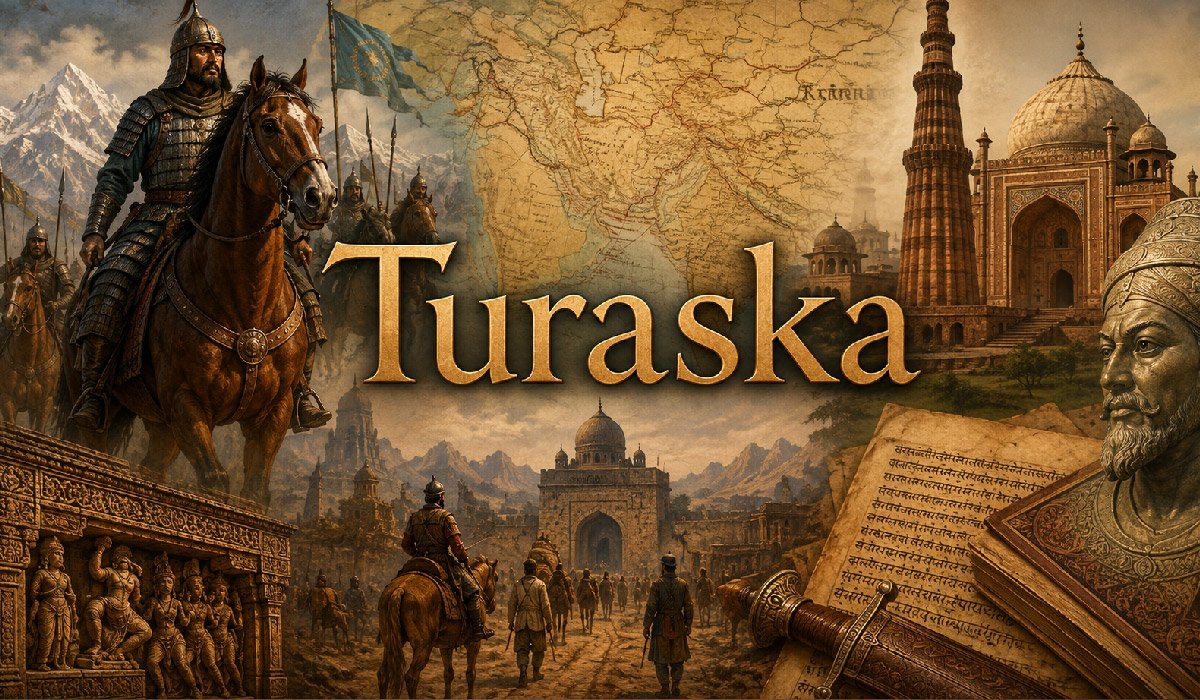
Turaska is a historical word connected with the long relationship between South Asia and peoples from Central Asia. The better-known Sanskrit form is Turuṣka, also written as Turushka in English. Indian texts used this term in different periods for peoples associated with regions northwest of the subcontinent, and it later became strongly connected with Turkic groups. Its meaning was not exactly the same in every source or century. Today, the word mainly appears in historical and language studies. A related modern form, তুরস্ক (Turaska), is also the Bengali name for Turkey. This article explains these meanings in their proper contexts.
Turaska Meaning and Definition
In historical discussion, Turaska generally refers to Turuṣka, a term found in Sanskrit and other Indian literary traditions. It became associated especially with Turkic peoples who entered or ruled parts of South Asia. However, it should not be understood as the precise name of one tribe or modern nationality. Historical writers sometimes used broad labels for communities they regarded as coming from outside their familiar political and cultural world. The meaning therefore depends on the period and text being studied. In modern Bengali, Turaska has a much simpler meaning: it is the common name used for the country of Turkey.
Sanskrit Origin of Turaska
The historical form most commonly encountered in Sanskrit is Turuṣka. In modern English writing, it can appear as Turushka because Sanskrit sounds and letters are represented differently under different transliteration systems. The term became connected with peoples of Central Asian and Turkic background in Indian literature. The exact deeper etymology should be treated carefully because explanations of how the word first developed are not always consistent. What can be said more safely is that Turuṣka became an established historical designation in South Asian texts. Its use changed as Indian societies encountered different political and military groups arriving through the northwestern regions.
Turaska, Turuṣka, and Turushka: Spelling Variations
Turaska, Turuṣka, and Turushka can appear in discussions of the same broad historical term, but their spellings reflect different languages and methods of writing Indian words in the Latin alphabet. Turuṣka is a scholarly transliteration that preserves the Sanskrit letter ṣ. Turushka is an easier English spelling because “sh” represents that sound without special characters. Turaska is also encountered online and has a separate modern importance in Bengali. Readers should therefore check the context instead of assuming every spelling has exactly the same use. Historical period, original language, and transliteration method can all affect the form of the word.
How the Meaning of Turaska Changed Over Time
Turaska did not carry one fixed meaning throughout South Asian history. Earlier Indian writings used various names for communities living beyond established political and cultural boundaries. As contact with Central Asian peoples increased, Turuṣka became more clearly associated with groups connected to the Turkic world. This association became particularly important during the medieval period, when rulers and military forces of Turkic background became powerful in parts of northern India. Political circumstances therefore helped shape the word’s meaning. Later, more specific names for dynasties, regions, and communities became common, while Turuṣka increasingly remained a term encountered in older literature and historical study.
Turaska in Ancient and Medieval Indian Literature
Turuṣka appears across Indian literary and historical traditions, but references must be dated carefully. The term is found in Sanskrit works and became especially visible in medieval writing dealing with foreign peoples and political conflict. One important example is Kalhana’s Rajatarangini, the famous Sanskrit chronicle of Kashmir completed in the 12th century. The term also appears in other literary traditions where writers describe peoples connected with areas beyond India’s northwestern frontiers. Such references are useful to historians, but they cannot always be read as exact ethnic classifications. Ancient and medieval authors used categories shaped by their own political, geographic, religious, and cultural viewpoints.
Turaska and Its Connection to Central Asia
The connection between Turaska and Central Asia reflects centuries of movement across the regions northwest of India. Mountain passes and trade routes linked the Indian subcontinent with Afghanistan, Iran, and wider Central Asia. Merchants, soldiers, religious figures, migrants, and political elites traveled through these networks. Turkic-speaking peoples became increasingly important across Central Asia during the first millennium CE and afterward. Their political expansion eventually brought several Turkic-led powers into close contact with South Asia. Indian writers consequently used terms such as Turuṣka when describing some of these groups. The relationship involved warfare, but it also included trade, migration, diplomacy, settlement, and cultural exchange.
How Turaska Became Associated With Turkic Peoples
The link between Turuṣka and Turkic peoples became stronger as Turkic-led states expanded toward South Asia. From the early medieval centuries onward, political changes in Central Asia and Afghanistan brought Turkic military elites closer to the Indian subcontinent. The Ghaznavids provide an important example of this development. Later Turkic and Turkic-led dynasties became involved in northern Indian politics as well. Indian writers increasingly had direct political reasons to describe these groups. As a result, Turuṣka became closely associated with Turkic soldiers and rulers in many medieval contexts. Even then, historical terminology remained flexible and should not be treated as an exact modern ethnic classification.
Turaska in Medieval Indian History
During the medieval period, references to Turuṣkas became more closely tied to real political events. Turkic-led powers based in Afghanistan and Central Asia conducted campaigns into northern India, while later dynasties established permanent states within the subcontinent. Mahmud of Ghazni, who ruled from 998 to 1030, carried out repeated campaigns in northern India. The Ghurid expansion during the late 12th century further changed the political landscape. These events gave Indian writers more direct experience with rulers and armies connected with the wider Turkic and Persianate world. Consequently, Turuṣka became a meaningful political and cultural label in medieval historical writing.
Turaska and the Delhi Sultanate
The establishment of the Delhi Sultanate in the early 13th century marked an important stage in the growth of Turkic political power in northern India. Qutb al-Din Aibak, a former military slave and commander under Muhammad of Ghor, became the first ruler of the Mamluk dynasty at Delhi in 1206. Several early Sultanate elites had Turkic backgrounds, although the Sultanate later included rulers, soldiers, officials, and communities of many origins. In this changing environment, older terms such as Turuṣka could be associated with powerful Muslim military groups. However, “Turuṣka” and “Delhi Sultanate” should not be treated as interchangeable historical terms.
Turkic Influence on Indian Politics and Culture
Turkic-led dynasties played an important part in medieval Indian political history. They strengthened cavalry-based military systems and developed states that drew heavily on Persianate administrative traditions. Persian became a major language of government and high culture under several Sultanate dynasties. These rulers did not operate in isolation from Indian society. They governed large populations with established political, economic, and cultural traditions and relied on people from different backgrounds. Over time, court practices, regional customs, artistic traditions, and administrative methods interacted. The result was not a simple replacement of one culture by another, but a complex process of political adaptation and cultural exchange.
Cultural Exchange Between Turkic and Indian Societies
Contact between Turkic-origin elites and Indian communities produced cultural exchange over many generations. Courts attracted scholars, poets, soldiers, administrators, merchants, artisans, and religious figures from different regions. Persianate traditions became influential, while local Indian practices continued and often interacted with them. Food, clothing, music, literature, architecture, and court customs developed through complicated regional processes rather than through a single source. Settlement also mattered. People who arrived from Central Asia or Afghanistan could become part of local communities over time. This long interaction helps explain why medieval South Asian culture cannot be divided neatly into separate “foreign” and “Indian” traditions.
Language, Persian Influence, and the Development of Urdu
Language provides an important example of cultural interaction in medieval South Asia. Persian became a leading administrative and literary language under the Delhi Sultanate and remained influential for centuries. Arabic contributed strongly through religion and scholarship, while people continued speaking many regional Indo-Aryan and Dravidian languages. Contact among speakers created multilingual environments, especially in military centers, courts, towns, and trading communities. Forms of Hindavi or Hindustani developed over a long period and later contributed to the literary traditions now associated with Hindi and Urdu. Urdu was therefore not created by one ruler or invasion. Its development resulted from centuries of linguistic contact and social change.
Turaska in the Deccan and Southern India
Political and cultural influences associated with northern Sultanate society eventually extended into the Deccan. The Delhi Sultanate expanded southward during the 14th century, and the Bahmani Sultanate emerged in the Deccan in 1347. Its society brought together local Deccani traditions with Persianate political and literary culture. Migrants from Iran, Central Asia, and other regions also became active in Deccan courts. However, it would be inaccurate to describe the entire Bahmani state simply as “Turaska.” Its population and ruling culture were much more diverse. The Deccan instead demonstrates how traditions carried across regions could develop new forms through local political, linguistic, and artistic interaction.
Why the Turaska Label Gradually Disappeared
Turuṣka became less useful as a broad label because South Asian political identities grew increasingly detailed. Writers could identify people by dynasty, region, language, religion, occupation, or political allegiance rather than grouping them under an older general term. New ruling houses also developed identities rooted in India while maintaining connections with Persianate and Central Asian traditions. During the Mughal period, political language reflected another changing imperial environment. The Mughals themselves traced important ancestry to Central Asia, but their court developed a distinctive Indo-Persian imperial culture. As older categories lost immediate political relevance, Turuṣka survived mainly in historical texts, literary works, inscriptions, dictionaries, and later scholarship.
Turaska as the Bengali Name for Turkey
Turaska has an important modern meaning that should be distinguished from the historical Sanskrit term. In Bengali, তুরস্ক, commonly transliterated as Turaska or Turask, is the standard name for Turkey (Türkiye). Bengali speakers therefore use the word when referring to the modern country located mainly in Anatolia, with a smaller part in southeastern Europe. This everyday geographic use is different from reading Turuṣka in an old Sanskrit or medieval Indian text. The two forms are linguistically connected with names associated with Turks, but context changes their meaning. A Bengali news report using Turaska normally means Turkey, not a medieval Central Asian community.
Is Turaska a Tribe, Ethnicity, Country, or Historical Term?
There is no single answer without knowing the context. In historical Sanskrit and related sources, Turuṣka is primarily a historical ethnocultural label that became strongly associated with Turkic peoples. It should not automatically be interpreted as the official name of one clearly defined tribe. Historical identities were often more fluid than modern national categories suggest. In medieval writing, the term could also carry political meaning because Turkic-origin rulers and soldiers were active in South Asia. In modern Bengali, however, Turaska has a clear geographic meaning: Turkey. Readers should therefore identify the language, date, and source before deciding what the word means.
Turaska Meaning Today
Today, Turaska is most likely to appear in two very different settings. Students of Sanskrit, medieval Indian history, inscriptions, or historical literature may encounter Turuṣka or Turushka as an old designation associated with Turkic or Central Asian peoples. Bengali speakers, meanwhile, encounter তুরস্ক as the ordinary name for modern Turkey. The historical term is no longer a normal ethnic label used for present-day populations. It belongs mainly to discussions of language and history. This distinction is especially important online, where unrelated modern definitions can easily be attached to uncommon words. Historical context provides a much more reliable explanation of Turaska than invented technological or business meanings.
Common Misunderstandings About Turaska
One common mistake is treating Turaska as the name of a single ancient tribe with fixed borders and ancestry. Historical terminology was rarely that simple. Another mistake is assuming that Turkic and Turkish mean exactly the same thing. Turkic refers to a broad family of peoples and languages spread across Eurasia, while Turkish usually refers specifically to Turkey and its main language and people. It is also misleading to identify every Turuṣka reference automatically with the modern Republic of Turkey. The modern Bengali meaning is different from historical Sanskrit usage. Understanding the date, language, author, and political setting helps prevent these errors.
Why Turaska Matters in South Asian History
Turaska matters because a single word can reveal how societies understood changing political and cultural boundaries. References to Turuṣkas reflect South Asia’s long connections with Afghanistan, Central Asia, and the wider Persianate world. Those connections involved military campaigns and political competition, but they also involved merchants, migrants, scholars, administrators, artists, and religious communities. Studying the term also warns against forcing modern national identities onto older historical sources. The people described by medieval writers lived in a world where political and cultural identities could overlap. Turaska therefore offers a useful starting point for understanding migration, language, state formation, cultural interaction, and changing perceptions of outsiders.
Conclusion
Turaska has a more specific and historically grounded story than many modern explanations suggest. In Sanskrit and medieval South Asian contexts, the related form Turuṣka became associated particularly with Turkic and Central Asian peoples who interacted with the Indian subcontinent. Its meaning developed as political contact increased and Turkic-led powers became important in northern India. Over time, more specific political and cultural identities reduced the need for this broad historical label. Today, it survives mainly in scholarship and older texts. At the same time, তুরস্ক remains the Bengali name for Turkey. Keeping these historical and modern meanings separate makes the term much easier to understand.
FAQs
What does Turaska mean?
Turaska can refer to the historical Sanskrit term Turuṣka, associated especially with Turkic and Central Asian peoples. In modern Bengali, Turaska is also used as the name for the country of Turkey.
Are Turaska and Turuṣka the same?
They are closely related forms encountered in discussions of the term. Turuṣka is the scholarly Sanskrit transliteration, while Turushka is a common English rendering. Turaska also has a distinct modern use in Bengali.
Was Turaska the name of one tribe?
Not necessarily. Historical writers could use Turuṣka as a wider label for peoples associated with the Turkic or Central Asian world. It should not be treated as one precisely defined modern ethnic group.
Why is Turaska connected with the Delhi Sultanate?
Several early Delhi Sultanate rulers and military elites had Turkic backgrounds. This political presence strengthened older Indian associations between terms such as Turuṣka and Turkic-origin soldiers, rulers, and political groups.
Does Turaska mean Turkey in Bengali?
Yes. The Bengali word তুরস্ক refers to modern Turkey. This everyday geographic meaning should be distinguished from historical Sanskrit uses of Turuṣka for peoples associated with Turkic and Central Asian backgrounds.
Is Turaska still used today?
The historical meaning is mainly encountered in scholarship, dictionaries, translations, and discussions of South Asian history. The Bengali form remains in normal modern use because it is the Bengali name for Turkey.
You may also read: Foxfiny com Explained: A Complete Guide for Users