

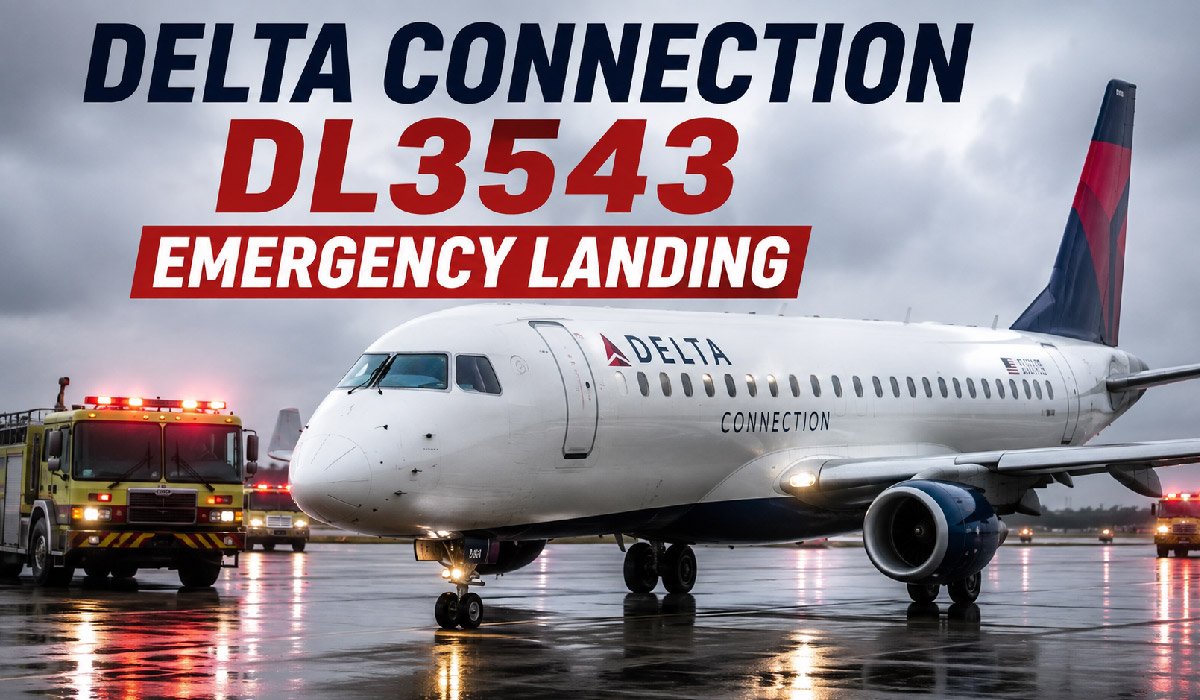
The Delta Connection DL3543 emergency landing attracted attention after the regional flight returned to Minneapolis instead of completing its planned journey to Chicago Midway. The flight had departed from Minneapolis–Saint Paul International Airport and initially appeared to be following a normal route. During the climb, however, the pilots decided that returning to Minneapolis was the safer course of action. The crew declared an emergency so the aircraft could receive priority assistance from air traffic control.
The word “emergency” can make an aviation story sound much more frightening than the actual situation. An emergency declaration does not always mean that an aircraft is in immediate danger. Pilots can declare one when they have a technical warning or another concern that makes a quick landing the safest choice. In the case of DL3543, the aircraft was able to return and land safely at Minneapolis.
No major injuries were reported following the landing. Reports surrounding the event have discussed a possible technical concern, including claims about aircraft pressurization. However, the precise technical reason should be treated carefully unless supported by clear official information. The incident is therefore best understood through the facts that are available: the crew identified a concern, stopped the planned journey, declared an emergency, and returned safely.
Delta Connection DL3543 Flight Details and Planned Route
Delta Connection DL3543 was operating as a regional passenger flight in the United States. The planned journey began at Minneapolis–Saint Paul International Airport, commonly identified by the airport code MSP. Its destination was Chicago Midway International Airport, one of the major airports serving Chicago. The route between Minneapolis and Chicago is relatively short compared with long-distance domestic or international flights, making it a common type of journey for regional airline operations.
Delta Connection is the regional brand associated with Delta Air Lines. Flights carrying the Delta Connection name are generally operated by regional airline partners rather than being operated directly as mainline Delta flights. The information provided about DL3543 identifies Endeavor Air as the regional operator. Reports also identify the aircraft involved as an Embraer E175, a regional jet widely used for short and medium-distance passenger services.
Nothing about the planned route itself suggested that the journey would become unusual. DL3543 was expected to depart Minneapolis, climb to its normal cruising level, and continue toward Chicago. Instead, the flight ended where it began. Shortly after departure, something caused the cockpit crew to reconsider continuing the journey. The pilots eventually turned the aircraft around, returned toward MSP, and prepared for a priority landing.
How the DL3543 Flight Began After Leaving Minneapolis
The beginning of DL3543 appears to have followed the familiar pattern of a normal commercial flight. After leaving Minneapolis–Saint Paul International Airport, the aircraft started climbing away from the airport. During this stage, pilots carefully watch the aircraft’s speed, altitude, engines, pressurization, electrical systems, flight controls, and many other readings. The climb is an important part of any journey because the aircraft is changing altitude quickly while transitioning toward normal cruise conditions.
Reports about DL3543 have stated that the aircraft climbed to around 21,000 feet before the planned journey changed. At such altitudes, the flight crew depends on cockpit instruments and automated monitoring systems to provide information about the condition of the aircraft. If a system detects something outside an expected range, pilots may receive an alert, message, warning light, or other indication requiring attention.
At some point during the climb, the pilots decided that continuing toward Chicago was not the preferred choice. That does not automatically mean the aircraft had suffered a major failure. Aviation crews are trained to respond to concerns before they develop into larger problems. Instead of continuing farther away from Minneapolis, the crew decided to return to an airport where the aircraft could land safely and where the reported issue could be properly examined on the ground.
Why Did Delta Connection DL3543 Turn Back to Minneapolis?
The biggest question surrounding the Delta Connection DL3543 emergency landing is why the aircraft returned. Based on the information surrounding the event, the pilots encountered a concern serious enough to change their original flight plan. Rather than continuing toward Chicago Midway, they chose to turn around and return to Minneapolis. This type of decision is made when the crew believes that landing and investigating a problem offers a safer option than continuing the journey.
Different online reports have described the reason in slightly different ways. Some have referred broadly to a technical issue, while others have connected the return with a possible warning involving cabin pressurization. These descriptions should not automatically be treated as proof of a particular mechanical failure. A cockpit warning can be caused by several conditions, and the information available to people tracking a flight from the ground is much more limited than the information available to the pilots.
What is clear is that the pilots took the concern seriously. Commercial aviation procedures are built around dealing with problems early. Crews do not need to wait for an issue to become dangerous before deciding to land. Returning to Minneapolis allowed DL3543 to remain close to a suitable airport while allowing maintenance professionals to inspect the aircraft after landing.
Was There a Cabin Pressurization Problem on DL3543?
Some reports discussing DL3543 have mentioned a possible pressurization warning, which makes it useful to understand what aircraft pressurization actually means. As an aircraft climbs, the outside air becomes thinner and contains less usable oxygen for people. Commercial aircraft therefore maintain a controlled cabin environment. A pressurization system helps keep conditions inside the passenger cabin suitable while the aircraft is flying at higher altitudes.
Modern aircraft constantly monitor this process. Sensors and other equipment provide information to the cockpit, and pilots can receive an alert if a reading is outside its expected range. However, there is an important difference between receiving a warning and experiencing a complete loss of cabin pressure. A warning can alert pilots to a condition that requires investigation before a dangerous situation develops. It can therefore lead to a return even when passengers do not experience a dramatic event.
For this reason, reports connecting DL3543 with pressurization should be described carefully. The available information does not justify automatically describing the event as a major decompression or complete pressurization failure. There is also no need to assume that passengers suddenly lost breathable cabin conditions. The safer interpretation is that a reported technical concern may have involved pressurization, while the exact underlying cause would require proper technical information to establish.
DL3543 Emergency Declaration and Squawk 7700 Explained
Another important part of the incident was the crew’s emergency declaration. Reports surrounding DL3543 indicate that the aircraft used transponder code 7700, often described in aviation as “squawk 7700.” Aircraft transponders send information that helps air traffic controllers identify and monitor flights. Certain numerical codes have special meanings, and 7700 is the general emergency code used when an aircraft requires special attention from controllers.
Using 7700 does not explain what has happened to an aircraft. The same general emergency code can be associated with many different situations. A pilot might use it because of a technical problem, medical situation, operational concern, or another condition requiring priority assistance. Therefore, seeing 7700 on a flight-tracking service does not prove that an aircraft is about to crash or that passengers are facing immediate danger.
For DL3543, the emergency declaration helped make the crew’s priority clear while they returned toward Minneapolis. Air traffic controllers could give the aircraft the attention and routing needed to reach the airport without unnecessary delay. The declaration also allowed ground services to prepare in case assistance was required after landing. In that sense, declaring an emergency is part of the aviation safety system. It gives pilots access to additional support while they concentrate on managing the aircraft.
How Air Traffic Control Helps During an Emergency Return
Air traffic control plays an important role when a commercial aircraft needs to return unexpectedly. Once controllers know that a flight has declared an emergency, they can give it priority over normal traffic when necessary. Their job is to provide a safe and efficient route while reducing unnecessary workload for the pilots. This may involve clearing other aircraft from the area, offering direct routing, coordinating an approach, and making sure the crew receives important airport information.
Communication also becomes especially important. The pilots need to concentrate on flying the aircraft, completing relevant procedures, and preparing for landing. Controllers can support them by managing the surrounding traffic and coordinating with other services. Depending on the circumstances, airport emergency teams may also receive information so that they can be positioned near the runway before the aircraft arrives.
In the case of DL3543, returning to Minneapolis provided the crew with a familiar and capable airport shortly after departure. Minneapolis–Saint Paul International Airport handles large numbers of commercial flights and has the facilities needed to support an unexpected return. The combination of pilot decisions, air traffic control assistance, and airport preparation created several layers of protection. These systems are designed to work together so an unusual flight situation can be managed in an organized way.
How DL3543 Returned Safely to Minneapolis
Once the pilots decided not to continue toward Chicago, DL3543 turned back toward Minneapolis–Saint Paul International Airport. Returning to the departure airport can be a practical choice when it remains nearby and has the runway, maintenance, airline, and emergency facilities needed to support the aircraft. It can also simplify arrangements because the airline already has an established operation at the airport where the journey began.
During a return, pilots still have several responsibilities. They must manage the aircraft, communicate with air traffic control, follow the necessary procedures, and prepare the cabin and cockpit for landing. If a technical warning is involved, the crew also has to consider how that condition might affect the approach or landing. Meanwhile, controllers can create an efficient route back to the airport and emergency services can prepare on the ground as a precaution.
The most important part of the DL3543 story is the outcome. The aircraft successfully returned to Minneapolis and landed safely. No major injuries were reported. The planned journey to Chicago was interrupted, but the crew had achieved the more important objective of bringing the aircraft back to the ground safely. The return demonstrates why pilots are given the authority to change a flight plan whenever they believe doing so provides the safer option.
What Passengers May Experience During an Unexpected Flight Return
An unexpected turnback can naturally be confusing for passengers. Most travelers have little information about what is happening in the cockpit. They may notice that the aircraft has stopped climbing, changed direction, or begun descending earlier than expected. An announcement that the flight is returning can also create concern, especially if passengers hear words such as “technical issue” or become aware that an emergency has been declared.
Cabin crews are trained for unusual situations as well as normal service. Their responsibilities include following instructions from the cockpit, making sure passengers remain seated when required, checking that seatbelts are fastened, securing the cabin, and preparing everyone for landing. Calm and clear communication can help prevent unnecessary confusion. Passengers are expected to follow crew instructions because conditions can change quickly even when the aircraft appears to be operating normally.
Specific claims about what individual DL3543 passengers saw, heard, or felt should not be added without reliable eyewitness information. There is no need to create dramatic details to explain the incident. The confirmed safe landing is more important. From a passenger’s perspective, an unexpected return can mean uncertainty, delays, and changed travel plans, but those inconveniences are secondary when pilots believe an aircraft should be inspected before continuing its journey.
Why Emergency Crews May Wait Near the Runway
When an aircraft declares an emergency, airport emergency services may be placed on standby before it arrives. Travelers sometimes see photographs or videos of fire engines and other emergency vehicles waiting near a runway and assume that authorities are expecting a crash. That is not necessarily the case. Positioning emergency crews nearby is a precaution that allows them to respond immediately if the aircraft needs assistance after landing.
Airport rescue and firefighting teams train specifically for aviation incidents. Depending on the information received, they can position vehicles in suitable locations while maintaining a safe distance from the runway. Other airport departments may also prepare to assist. This preparation is useful because emergency situations can change, and having trained personnel already in position reduces response time if help suddenly becomes necessary.
For an event such as the DL3543 return, emergency readiness should therefore be viewed as another layer of protection rather than evidence that the aircraft was expected to suffer a serious accident. The goal is preparation. If the landing is completely normal, emergency crews may never need to intervene. If assistance is required, they are already close enough to respond quickly. This cautious approach reflects the wider aviation principle of preparing for a more serious outcome while working toward a safe and routine landing.
What Happened After Delta Connection DL3543 Landed?
A safe landing does not automatically end the response to a technical return. Once DL3543 was back on the ground, attention could shift from getting the aircraft safely to the airport to understanding why the crew had returned. An aircraft involved in an unexpected technical return normally needs appropriate inspection before it can simply continue normal passenger operations. Maintenance professionals can examine the concern reported by the pilots and determine whether additional work is required.
Passengers also face practical problems after an aircraft returns to its departure airport. The people on DL3543 had expected to reach Chicago Midway, but they were instead back in Minneapolis. In situations like this, airline staff generally work to help affected travelers continue their journeys. Depending on available flights and operational conditions, that can involve rebooking passengers or providing updated travel arrangements. The exact assistance provided should not be assumed without specific information from the airline.
A disrupted journey can be frustrating. Travelers may miss connecting flights, appointments, business meetings, or personal plans. However, aviation safety decisions are not based on avoiding inconvenience. If pilots believe a warning needs investigation, returning is preferable to continuing simply to maintain the schedule. Delays can be solved later; unresolved aircraft concerns need immediate attention.
How an Aircraft Is Checked After an Emergency Return
Technical inspections are an important part of what happens after an aircraft returns because of a warning or suspected problem. Maintenance professionals first need accurate information about what the flight crew observed. Pilots can describe cockpit messages, warning indications, unusual readings, or other conditions that influenced their decision. Technicians can then focus their inspection on systems related to those reports rather than relying on guesses about what happened.
Modern aircraft also store large amounts of technical information. Maintenance teams may be able to review recorded fault messages and aircraft computer data to understand whether a sensor, component, or system produced an unusual reading. They can perform tests and inspect relevant equipment. If a component is found to be defective, it may need repair or replacement before the aircraft is cleared for normal operation.
If the concern surrounding DL3543 was connected with pressurization, technicians could examine equipment associated with controlling and monitoring cabin pressure. However, discussing those possible checks does not prove that any particular component failed. The important point is that an aircraft is not simply assumed to be safe because it landed normally. Maintenance procedures exist to identify the source of warnings and make sure the aircraft meets required standards before returning to passenger service.
Confirmed Facts and Online Claims About DL3543
The Delta Connection DL3543 emergency landing has been discussed across aviation pages and other online sources, and different descriptions can make the story confusing. Some accounts describe a general technical concern, while others specifically mention cabin pressurization. When reporting an aviation event, it is important to separate information that is reasonably established from explanations that remain uncertain. A flight’s movements may be visible publicly, but the technical reason behind those movements is often harder to establish immediately.
The basic story is clearer. DL3543 departed Minneapolis for a planned journey to Chicago Midway, but the crew did not complete that trip. The aircraft turned back toward Minneapolis, an emergency was declared, and the flight landed safely. No major injuries were reported. These points explain what happened without requiring speculation about an exact mechanical fault.
Flight-tracking information can be very useful, especially for showing an aircraft’s route, altitude, direction, and certain transponder information. However, a tracking screen cannot see inside the cockpit or diagnose an aircraft system. This is why technical claims require greater care. Describing an unconfirmed warning as a proven failure can make an incident sound more serious than the available evidence supports and can give readers an inaccurate understanding of what occurred.
What Does an Emergency Landing Actually Mean?
The phrase “emergency landing” covers a wide range of aviation situations. Some emergencies are extremely serious and require immediate action. Others are precautionary situations in which an aircraft remains controllable but the pilots decide that landing sooner is safer than continuing. The phrase alone therefore cannot tell readers how much danger passengers actually faced. The circumstances surrounding the declaration are more useful than the word “emergency” by itself.
Pilots may declare an emergency when they need priority handling or additional assistance. This gives air traffic controllers clear notice that the flight requires special attention. Depending on the situation, controllers can provide a direct route, clear surrounding traffic, coordinate with airport teams, and help the aircraft land without unnecessary delay. This support can be valuable even when the underlying problem later turns out to be minor.
DL3543 is a useful example of why aviation headlines require context. The aircraft returned rather than completing its planned flight, and an emergency declaration was reportedly made. Yet the aircraft was able to land safely and no major injuries were reported. The emergency procedures were therefore part of managing the concern. They should not automatically be interpreted as evidence that the aircraft had reached the point of a catastrophic failure.
Why Pilots Return Even When an Aircraft Is Still Flying Normally
A passenger might wonder why pilots return to an airport when an aircraft still appears to be flying normally. The answer lies in how aviation risk is managed. Pilots are not expected to wait until an aircraft becomes difficult to control before responding to a warning. Aircraft systems are designed to alert crews early, giving them time to understand a condition and take action while several safe options remain available.
When deciding what to do, pilots can consider the nature of the warning, aircraft condition, weather, nearby airports, fuel, maintenance support, runway availability, and other operational factors. They also follow airline procedures and aircraft checklists. Sometimes the correct response is to continue. In other circumstances, the safer decision is to divert to another airport or return to the airport of departure.
For DL3543, returning to Minneapolis meant that the aircraft could be examined instead of continuing toward Chicago with an unresolved concern. This type of conservative decision-making is an important part of commercial aviation. A turnback may cause significant inconvenience and can look alarming on a flight tracker, but it can also show that the crew is responding before a possible problem has an opportunity to become more serious.
Why Pilot Training and Checklists Matter During an Emergency
Airline pilots receive extensive training for both normal flights and unexpected situations. Simulator sessions allow crews to practice technical problems, abnormal indications, emergency procedures, diversions, and other events in a controlled environment. The goal is not to predict every possible incident. Instead, training helps pilots develop structured ways of identifying problems, dividing responsibilities, communicating clearly, and making safe decisions when something unusual occurs.
Checklists are another important part of this process. A cockpit contains many systems, and pilots should not have to depend entirely on memory when managing an abnormal condition. The correct checklist can guide the crew through required steps and help ensure that important actions are not overlooked. One pilot may focus mainly on controlling the aircraft while the other handles communications, procedures, or other tasks, depending on the situation.
The DL3543 return demonstrates why this structured approach matters. The crew had to change a normal flight plan after departure and bring the aircraft back to Minneapolis. The exact cockpit procedures used are not available from the information provided, so they should not be invented. What can be explained is the wider system: professional training, standard procedures, crew coordination, checklists, air traffic control, and ground support all help pilots manage unexpected situations safely.
How Modern Regional Jets Respond to Technical Warnings
Modern regional aircraft contain many systems designed to monitor their condition throughout a flight. Sensors and computers watch important functions and provide information to the pilots. When something moves outside its expected range, the cockpit may display a message, caution, or warning. This early notification allows pilots to investigate and follow the correct procedure rather than waiting until an issue becomes obvious through a major change in aircraft performance.
A warning also does not necessarily mean that an entire system has failed. In some cases, a sensor may detect an unusual reading while backup systems continue operating. In other cases, the warning may point to a condition that needs attention but does not immediately affect the pilots’ ability to control the aircraft. This is one reason aviation events should not be described as catastrophic failures simply because a technical warning has been reported.
The Embraer E175 identified in reports about DL3543 belongs to a class of modern regional passenger jets designed for regular commercial service. Like other commercial aircraft, it operates within detailed procedures covering maintenance and flight operations. When a warning creates enough concern to justify returning, the safest response may be to land and allow trained technicians to investigate. That approach uses the warning system for exactly what it is intended to do: provide information early enough for action.
Why the Delta Connection DL3543 Story Attracted Attention
Unusual flights can attract attention very quickly because modern flight-tracking services allow people to watch aircraft movements almost in real time. A flight that suddenly turns around, changes altitude, diverts to another airport, or displays an emergency transponder code can quickly become a topic on social media and aviation websites. Screenshots may begin circulating before passengers have even left the aircraft or before an airline has provided detailed information.
This speed has advantages because travelers can receive updates quickly. However, it also creates a problem. People watching a flight from the ground can see what the aircraft is doing, but they usually cannot see why the pilots are doing it. A sudden return can therefore lead to speculation about engines, cabin pressure, smoke, medical emergencies, or other possible causes before reliable information becomes available.
DL3543 shows why readers should separate observation from explanation. The aircraft’s return to Minneapolis and emergency handling can tell us that the crew considered the situation important enough to land. They do not, by themselves, prove exactly what component or system caused the decision. Responsible coverage should explain known facts clearly while avoiding dramatic technical claims that have not been properly established.
What Travelers Can Learn From the DL3543 Emergency Landing
The DL3543 incident offers a useful lesson about how travelers should understand turnbacks, diversions, and emergency declarations. An unexpected change to a flight can be worrying, especially when passengers do not immediately know why it is happening. However, returning to an airport can be a sign that safety procedures are being followed. Pilots are expected to act when a concern appears rather than continue simply because passengers want to reach their destination on time.
Passengers can also help during unusual situations by listening closely to cabin crew instructions. If travelers are told to remain seated, fasten their seatbelts, put away personal items, or prepare for landing, they should follow those directions promptly. Cabin crew members receive safety training and need the cabin prepared correctly so the pilots can concentrate on operating the aircraft.
The incident also shows why travelers should be cautious about early claims circulating online. A flight tracker can confirm that an aircraft turned around, but it cannot always explain the technical reason. Waiting for stronger information can prevent a precautionary event from being mistaken for a disaster. In DL3543’s case, the central outcome remains straightforward: the planned journey changed, the pilots returned, and the aircraft landed safely.
Final Thoughts
The Delta Connection DL3543 emergency landing began with what was expected to be a routine regional journey from Minneapolis–Saint Paul International Airport to Chicago Midway. After departure, however, the crew encountered a concern and decided not to continue toward Chicago. Reports indicate that an emergency was declared, allowing the flight to receive priority assistance as the pilots turned back toward Minneapolis.
The aircraft returned safely to MSP, and no major injuries were reported. Some reports surrounding the event have connected the decision with a possible technical or cabin pressurization warning. That possibility should be distinguished from a confirmed major pressurization failure. Without stronger technical evidence, it is more accurate to say that the precise cause of the warning remains less clear than the basic sequence of the flight.
Most importantly, the event demonstrates several layers of aviation safety working together. Aircraft monitoring systems can alert pilots to unusual conditions. Trained crews can respond with established procedures. Air traffic controllers can provide priority assistance, airport teams can prepare for the return, and maintenance workers can inspect the aircraft afterward. DL3543 did not reach Chicago as planned, but returning safely rather than continuing with an unresolved concern reflects the cautious approach commercial aviation is designed to take.
FAQs
Why did Delta Connection DL3543 make an emergency landing?
Delta Connection DL3543 returned to Minneapolis after the crew identified a concern during the flight. Reports mentioned a possible technical or pressurization warning, but the exact technical cause has not been clearly established.
Where was Delta Connection DL3543 going?
Delta Connection DL3543 was traveling from Minneapolis–Saint Paul International Airport to Chicago Midway International Airport. The aircraft turned back before completing the planned journey and safely returned to Minneapolis.
Was anyone injured during the DL3543 emergency landing?
No major injuries were reported following the Delta Connection DL3543 emergency landing. The aircraft returned safely to Minneapolis, where airport and airline teams could respond to the situation.
What does squawk 7700 mean on DL3543?
Squawk 7700 is the general emergency transponder code used in aviation. It tells air traffic controllers that an aircraft requires special attention and may need priority routing or landing assistance.
Was cabin pressure the reason DL3543 returned?
Some reports connected the DL3543 return with a possible pressurization warning. However, a warning is not necessarily a complete cabin pressure failure, and the precise technical cause should not be presented as confirmed without stronger evidence.
You may also read: Çbiri: Meaning, Origin, Uses, and Everything You Need to Know