

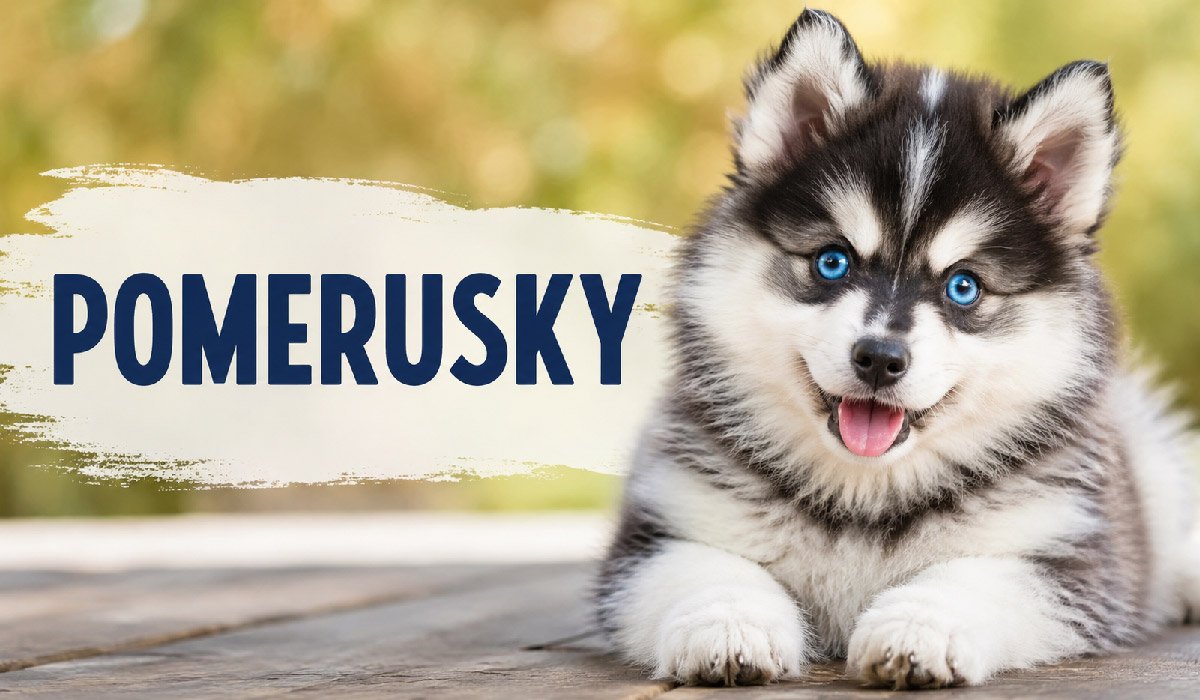
Have you come across the word Pomerusky while searching for a small, fluffy dog that looks like a Siberian Husky? The name sounds unusual, but it describes a popular designer dog.
The Pomerusky attracts attention because of its Husky-like face, fluffy coat, compact body, and lively personality. Photos and videos of these dogs have also made the cross popular online.
This guide explains what Pomerusky means and explores its origin, appearance, size, temperament, training, exercise, grooming, food, health, lifespan, family suitability, costs, and important ownership needs.
What Is a Pomerusky?
A Pomerusky is a cross between a Pomeranian and a Siberian Husky. The same cross is much more widely known as a Pomsky. Therefore, people searching for Pomerusky are usually looking for information about the Pomsky.
It is a mixed-breed or designer dog rather than a separate purebred breed. Puppies can inherit different combinations of features from their Pomeranian and Siberian Husky parents.
Some have striking Husky-style facial markings in a smaller body. Others show stronger Pomeranian characteristics, including a very fluffy coat and smaller frame. This variation is an important part of understanding the Pomerusky.
Pomerusky Meaning and the Pomsky Name
The meaning of Pomerusky becomes easier to understand when the word is separated into its breed references. “Pomer” points toward the Pomeranian, while “Husky” refers to the Siberian Husky.
However, Pomsky is the more established name for this particular cross. Pomerusky may appear as an alternative online term used by people describing the same type of dog.
For this reason, searches for Pomerusky and Pomsky can lead to very similar information. Owners should focus more on the dog’s actual parentage, health, temperament, and care needs than on which of these names is used.
Why Is the Pomerusky So Popular?
Appearance is a major reason people become interested in the Pomerusky. Many puppies combine a thick fluffy coat with pointed ears, an expressive face, and markings that can resemble a miniature Siberian Husky.
Social media has helped this appearance reach a huge audience. A small dog with blue eyes, contrasting facial markings, or a fluffy tail can easily attract attention in photographs and short videos.
Looks are only part of the appeal. The combination of two intelligent and energetic parent breeds can produce an entertaining companion. However, potential owners should understand its needs before choosing one based mainly on appearance.
Pomerusky Origin and Development
The Pomerusky belongs to the modern designer-dog trend in which two established breeds are intentionally crossed. The Pomsky became particularly visible during the early 2010s as interest in unusual small companion dogs increased.
The idea attracted attention because Pomeranians and Siberian Huskies have very different sizes but share several visually appealing traits. Both can have thick coats, pointed ears, lively expressions, and confident personalities.
Unlike breeds developed according to a long-established uniform standard, mixed dogs can show considerable variation. This means one Pomerusky puppy may develop quite differently from another, even when they share similar ancestry.
How Pomeruskies Are Bred
Breeding Pomeranians with Siberian Huskies requires special consideration because there is a major size difference between the two breeds. Responsible breeding must place the health and safety of the dogs above appearance.
Artificial insemination has commonly been associated with producing first-generation Pomsky litters. When the original parent breeds are used, the larger Siberian Husky is generally the female because pregnancy involving oversized puppies could be dangerous for a small Pomeranian.
Breeding practices can become different in later generations because adult mixed dogs may be closer in size. Anyone considering a puppy should choose a breeder who performs appropriate health testing and explains the puppy’s parentage clearly.
Understanding F1, F1b, and F2 Pomeruskies
You may encounter labels such as F1, F1b, and F2 while researching Pomerusky puppies. These terms describe generations or breeding combinations rather than guaranteeing a particular appearance, size, or personality.
An F1 dog is produced directly from a Pomeranian and Siberian Husky. An F2 generally results from breeding two F1 dogs. The term F1b usually describes an F1 dog bred back to one of its parent breeds.
These labels can help explain ancestry, but genetics remain unpredictable. Two puppies from the same litter can still have different coats, sizes, facial features, and temperaments. Generation labels should therefore never replace careful evaluation of the individual dog.
Pomerusky Size and Weight
There is no single guaranteed adult size for every Pomerusky. The parent breeds differ greatly in size, so adult weight and height depend on genetics, parent size, generation, nutrition, sex, and general development.
Many Pomskies fall into the small-to-medium companion-dog range, but some are noticeably larger or smaller than others. Labels such as toy, mini, or standard may also be used, although terminology can vary between breeders.
Prospective owners should ask about the actual sizes of the parents rather than relying only on a marketing label. Even then, predicting the exact adult size of a young mixed-breed puppy is difficult.
Pomerusky Appearance and Body
The Pomerusky is famous for an appearance that can combine characteristics of both parent breeds. Pointed or semi-pointed ears, a fluffy tail, alert expression, and thick coat are commonly associated with the cross.
Some dogs strongly resemble smaller Huskies. They may have noticeable facial masks and an athletic body. Others inherit a rounder face, shorter muzzle, smaller frame, or especially thick coat from their Pomeranian side.
Because it is a crossbreed, there is no single appearance that every Pomerusky must have. This variety is one reason buyers should avoid assuming that a puppy will look exactly like photographs seen online once fully grown.
Pomerusky Coat and Colors
Both parent breeds have double coats, so a Pomerusky commonly develops a dense coat consisting of softer undercoat beneath protective outer hairs. The exact length and texture can vary considerably between individual dogs.
Possible colors and patterns are diverse. Black, gray, white, cream, brown, red, and combinations of these shades may appear. Husky-style masks and contrasting markings can make some dogs particularly distinctive.
Coat appearance can also change as a puppy matures. Color should never be the main factor when selecting a dog. Health, responsible breeding, temperament, and suitability for your lifestyle are much more important considerations.
Pomerusky Eyes and Facial Features
The eyes are one of the features that often attract people to the Pomerusky. Depending on genetics, a dog may have brown, blue, or differently colored eyes.
Having two eyes of different colors is known as heterochromia. Siberian Huskies are among the breeds in which this feature can occur, so it may also appear in their mixed offspring.
Not every Pomerusky has blue eyes, however. Brown eyes are completely normal and do not make a dog less authentic. Eye color is mainly a physical characteristic and should not be considered more important than eye health or overall wellbeing.
Pomerusky Personality and Temperament
Pomeruskies can be affectionate, playful, energetic, alert, and curious. Both parent breeds have strong personalities, meaning their mixed offspring may become entertaining dogs that enjoy being involved in everyday family activities.
A dog may inherit the outgoing nature often associated with Pomeranians or some of the independence commonly seen in Huskies. Individual temperament is also shaped by early experiences, socialization, training, and environment.
Because mixed-breed temperament cannot be predicted perfectly, owners should be prepared for variation. Meeting the puppy’s parents when possible and learning about their temperaments can provide useful clues about the characteristics a puppy might develop.
Intelligence and Vocal Behavior
Both Siberian Huskies and Pomeranians are intelligent dogs, although intelligence does not always mean automatic obedience. A Pomerusky may understand commands quickly while still becoming distracted or choosing something more interesting.
Vocal behavior can also be noticeable. Some individuals bark frequently, while others may whine, howl, or make expressive sounds. This can become challenging in apartments when the behavior is not managed appropriately.
Owners can reduce unwanted noise by providing exercise, mental stimulation, training, and a predictable daily routine. Excessive vocal behavior can sometimes signal boredom, excitement, anxiety, or another need that should be identified rather than simply punished.
Training a Pomerusky
Training should begin when a Pomerusky is young. Basic skills such as responding to its name, coming when called, sitting calmly, walking appropriately, and settling indoors create a useful foundation for everyday life.
Reward-based training is generally the best approach. Food rewards, toys, praise, and play can encourage desired behavior. Short sessions can be particularly useful for maintaining the attention of an energetic young dog.
Consistency matters because intelligent dogs quickly learn which rules are flexible. Harsh punishment can create fear without teaching the desired behavior. Clear boundaries, patience, appropriate rewards, and regular practice usually provide a much healthier learning experience.
Socialization and Early Development
Socialization is another important part of raising a balanced Pomerusky. Puppies benefit from carefully managed positive experiences with different people, environments, surfaces, household sounds, handling, and suitable animals.
Good socialization does not mean forcing a frightened puppy into overwhelming situations. Experiences should be gradual and positive so the puppy learns that unfamiliar parts of everyday life do not automatically represent danger.
Early development can influence behavior well into adulthood. Puppy classes can be useful when they are appropriately managed. Owners should also follow veterinary guidance about safe exposure while a puppy is completing its recommended vaccination schedule.
Pomerusky Exercise Needs
A Pomerusky may be smaller than a Siberian Husky, but that does not automatically make it a low-energy dog. Many are active companions that need regular opportunities to walk, play, explore, and use their minds.
The correct amount of exercise depends on age, health, size, and individual energy level. Adult dogs may enjoy daily walks combined with play and training, while growing puppies require exercise appropriate for their developing bodies.
Physical activity alone is not enough for every energetic dog. Scent games, food puzzles, training exercises, and safe exploration provide mental stimulation. A balanced routine can help reduce boredom and make indoor behavior easier to manage.
Grooming and Shedding
Potential owners should expect shedding. A thick double coat naturally releases hair, and shedding can become particularly noticeable when seasonal coat changes occur.
Regular brushing removes loose hair and helps prevent tangles. The required frequency depends on coat length, density, and season. During periods of heavy shedding, owners may need to brush considerably more often.
Bathing should be based on the dog’s needs rather than an unnecessarily rigid schedule. Nails should be trimmed when required, ears checked regularly, and teeth cared for consistently. The double coat should not normally be shaved simply to reduce shedding.
Food and Nutrition
A Pomerusky needs a complete and balanced diet appropriate for its age and life stage. Puppies have different nutritional requirements from adults, while senior dogs may need adjustments as their activity and health change.
The correct serving size depends on the dog’s body weight, food type, activity level, age, and metabolism. Feeding based only on a general online measurement can lead to either too many or too few calories.
Fresh water should always be available. Treats also contribute calories and should be considered as part of the overall diet. If a dog develops persistent digestive problems, itching, weight changes, or other symptoms, veterinary advice is more useful than randomly removing ingredients.
Pomerusky Health and Common Concerns
Crossbreeding does not guarantee that a dog will be free from inherited health problems. A Pomerusky can potentially develop conditions associated with either Pomeranians or Siberian Huskies, making responsible breeding and health screening important.
Possible concerns can involve the eyes, joints, teeth, kneecaps, skin, or other body systems. The actual risk differs between individual dogs, so a list of possible conditions should not be treated as a prediction that every Pomerusky will become ill.
Routine veterinary examinations help monitor general health. Owners should also maintain appropriate vaccinations, dental care, parasite prevention, healthy body weight, exercise, and nutrition according to advice from their veterinarian.
Pomerusky Lifespan and Long-Term Care
A Pomerusky can potentially remain part of a household for well over a decade. Lifespan varies because genetics, body size, health conditions, nutrition, veterinary care, environment, and lifestyle all influence longevity.
Long-term ownership means planning beyond the puppy stage. An energetic young dog eventually becomes an adult and later a senior that may need different exercise, food, medical monitoring, and home arrangements.
Keeping the dog at a healthy weight is particularly valuable because excess weight places additional pressure on the body. Regular veterinary care and attention to changes in appetite, movement, behavior, or energy can also help identify developing problems earlier.
Living With a Pomerusky in an Apartment
A Pomerusky can potentially live in an apartment. The size of the home is only one part of the decision because exercise, mental stimulation, training, and noise management can matter even more.
An energetic dog that receives appropriate walks and activities may settle better indoors than an under-stimulated dog living in a large house. Vocal behavior, however, can become an issue when neighbors live close by.
Apartment owners should have a realistic plan for bathroom breaks, daily exercise, training, and enrichment. A yard is convenient but does not replace interaction or walks. What matters most is whether the owner can consistently meet the dog’s needs.
Pomeruskies With Children and Other Pets
A well-socialized Pomerusky can become a loving family companion, but compatibility with children depends on the individual dog’s temperament, training, experiences, and the way children interact with animals.
Young children should be supervised around dogs. They need to learn not to pull fur, disturb a sleeping dog, take food away, or treat a small pet like a toy.
Living with other dogs or cats may also be possible, especially with thoughtful introductions and early socialization. However, individual behavior varies. Owners should manage introductions carefully rather than assuming every Pomerusky will automatically become friendly with every animal.
Leaving a Pomerusky Home Alone
Pomeruskies often enjoy interaction with their families. However, individual dogs differ in how comfortably they cope when people leave the home.
Teaching independence gradually can help. A puppy can learn to relax in a safe space for short periods before the duration is slowly increased. Providing suitable enrichment can also make alone time easier.
Dogs should not suddenly be expected to tolerate long periods alone without preparation. Persistent barking, destruction, attempts to escape, pacing, or distress may indicate a behavioral problem that needs attention. Professional veterinary or qualified behavioral support can be useful in serious cases.
Pomerusky Price and Ownership Costs
The purchase price of a Pomerusky varies greatly according to location, breeder practices, ancestry, demand, and other factors. Advertised prices can therefore differ significantly rather than fitting one reliable worldwide range.
The initial purchase is only one expense. Owners also need to budget for food, veterinary care, vaccinations, parasite prevention, grooming equipment, bedding, leads, harnesses, training, toys, and emergency medical needs.
Pet insurance may be another expense depending on the country and owner’s circumstances. A lower purchase price does not necessarily make a puppy a better deal. Health practices and responsible breeding should carry more weight than unusual colors or fashionable features.
Finding a Responsible Pomerusky Breeder
Choosing where a puppy comes from is one of the most important decisions a future owner makes. Responsible breeders should care about health and temperament rather than producing puppies mainly for fashionable appearances.
Ask about health testing performed on the parents and request appropriate documentation. Buyers should also learn about the puppy’s early environment, socialization, veterinary care, parentage, and the breeder’s policies.
Be cautious when sellers guarantee an exact adult size, personality, or appearance that cannot realistically be predicted. Responsible breeders should also ask potential buyers questions because they want their puppies placed in homes capable of providing suitable lifelong care.
Adoption and Rescue Options
Buying from a breeder is not the only possible way to find this type of dog. Mixed dogs, including Pomskies and similar Husky or Pomeranian crosses, can sometimes enter shelters and rescue organizations.
Adopting an adult dog can have advantages. Its approximate size, coat, energy level, and basic temperament may already be easier to observe than those of a very young puppy.
Potential adopters should still ask about known health and behavioral needs. Rescue organizations can often explain what they have observed while caring for the dog. Matching the individual animal to the household remains more important than finding a particular fashionable appearance.
Is a Pomerusky Right for You?
A Pomerusky may suit someone who wants an intelligent, energetic, fluffy companion and has enough time for exercise, training, grooming, socialization, and daily interaction.
It may be less suitable for someone seeking an extremely low-maintenance dog. Shedding can be substantial, behavior can sometimes be independent or vocal, and appearance and adult size are not completely predictable.
Before getting one, think beyond the attractive mini-Husky appearance. Consider whether your schedule, housing, finances, experience, and long-term plans can support the individual dog’s needs for its entire life.
Final Thoughts
The Pomerusky, more commonly known as the Pomsky, is a cross between a Pomeranian and a Siberian Husky. Its fluffy appearance, expressive face, and possible Husky-like markings explain much of its modern appeal.
Behind that appearance is a dog that may be energetic, intelligent, vocal, affectionate, independent, or a mixture of these characteristics. Genetics and upbringing make every individual slightly different.
For the right household, a Pomerusky can become an engaging companion for many years. Responsible breeding or adoption, patient training, regular grooming, suitable exercise, veterinary care, and realistic expectations are more important than choosing one simply for its looks.
(FAQs)
What does Pomerusky mean?
Pomerusky is an alternative name used for a Pomeranian and Siberian Husky cross. This designer dog is much more commonly called a Pomsky. Both terms generally refer to the same parent-breed combination.
Is a Pomerusky the same as a Pomsky?
Yes, Pomerusky is generally used to describe the same Pomeranian-Husky cross commonly known as a Pomsky. Pomsky is the more established and widely recognized name.
How big does a Pomerusky get?
Adult size can vary considerably because Pomeranians and Siberian Huskies are very different in size. Parent size and genetics provide useful clues, but an exact adult height or weight cannot be guaranteed for every puppy.
Do Pomeruskies shed a lot?
Many Pomeruskies shed noticeably because both parent breeds have double coats. Regular brushing helps remove loose hair, while more frequent grooming may be necessary during periods of heavier seasonal shedding.
Are Pomeruskies good family dogs?
They can be good family companions when their temperament suits the household and they receive proper socialization and training. Children should learn respectful dog handling, and interactions with young children should always be appropriately supervised.
You may also read: Portar Leisa: Amazing Hidden Travel Guide for Nature Lovers