

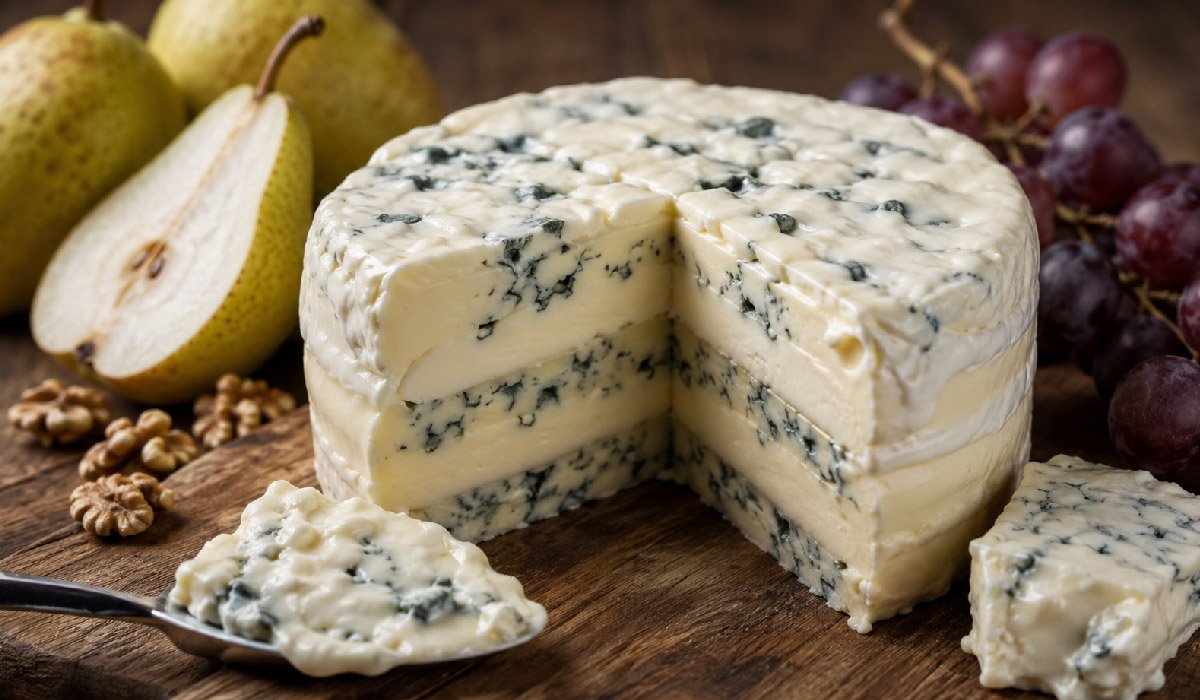
Masgonzola is a creamy dairy specialty that brings together two famous Italian products: Gorgonzola and mascarpone. The combination keeps the distinctive character of blue cheese while adding the rich, smooth texture of mascarpone. Some versions are blended, while others are made with visible alternating layers. There is no single universal recipe, so flavor and nutrition can differ between products. In this guide, we explain what Masgonzola is, how it is prepared, what it tastes like, how it compares with Gorgonzola, and the best ways to use, buy, serve, and store it.
What Is Masgonzola?
Masgonzola is commonly used as a convenient name for a dairy preparation that combines Gorgonzola with mascarpone. It should not be confused with a completely separate blue cheese variety. Commercial examples show that these two cheeses may be placed in alternating layers, creating a product with both white mascarpone and blue-veined Gorgonzola. Italian producer CasArrigoni describes its version as a preparation made from layers of mascarpone and mild Gorgonzola. The result combines the buttery softness of mascarpone with the stronger character of blue cheese.
Is Masgonzola a Real Cheese or a Cheese Specialty?
Products matching the Masgonzola description are real, but Masgonzola is better understood as a cheese specialty rather than a separately protected cheese variety. Gorgonzola itself has PDO status and must follow regulated production standards. A Gorgonzola-and-mascarpone preparation does not have a separate Masgonzola PDO specification. Producers can therefore use different proportions and presentation styles. This distinction matters because some online descriptions treat Masgonzola as an independent historic blue cheese. Available producer information instead supports describing it as a product made by combining mascarpone with genuine Gorgonzola.
Where Does the Name Masgonzola Come From?
The name Masgonzola appears to combine parts of the words “mascarpone” and “Gorgonzola.” That interpretation fits the product itself, although there is no reliable evidence showing an official historical origin for the term. It should therefore be treated mainly as an informal or commercial name rather than the traditional name of an independent Italian cheese. Producers often avoid the word completely and simply label their products “Gorgonzola and Mascarpone.” This is also why shoppers may find the food even when Masgonzola itself does not appear anywhere on the package.
What Is Masgonzola Made Of?
The two key components are mascarpone and Gorgonzola. Mascarpone contributes richness, moisture, and a mild buttery taste. Gorgonzola adds saltiness, blue veining, creaminess, and a more noticeable savory flavor. There is no standard ratio that applies to every product. Conad, for example, lists one commercial version as 60% mascarpone and 40% Gorgonzola DOP. Other producers can use different proportions. Because formulas vary, ingredients and nutrition should always be checked on the individual package instead of assuming that every Masgonzola product is identical.
Understanding the Gorgonzola in Masgonzola
Gorgonzola is the ingredient that gives Masgonzola its blue-cheese identity. Genuine Gorgonzola PDO is an Italian cheese associated with specific areas of Lombardy and Piedmont and is produced under controlled rules. It contains the familiar blue-green veining that develops during production and maturation. Its texture and strength depend partly on the style. Gorgonzola Dolce is generally softer and gentler, making it particularly suitable for creamy preparations. A producer such as CasArrigoni specifically uses mild Gorgonzola in its layered Gorgonzola-and-mascarpone specialty.
The Role of Mascarpone in Masgonzola
Mascarpone changes both the flavor and texture of the finished product. It has a delicate dairy taste and a smooth, rich consistency. When combined with Gorgonzola, it reduces the intensity of the blue-cheese flavor without removing it completely. CasArrigoni describes its mascarpone layers as smooth, dense, white to pale yellow, with a sweet and buttery character. This contrast is important. The mascarpone provides richness and softness, while the Gorgonzola contributes sharper and more savory notes. Increasing the amount of mascarpone generally produces a gentler, more luxurious result.
How Masgonzola Is Made
There is no legally defined Masgonzola manufacturing process. The documented commercial approach starts with prepared mascarpone and Gorgonzola and brings them together into one finished dairy specialty. One well-established method involves alternating layers of the two components. This keeps their different colors, textures, and flavors visible. Other products may combine them more evenly. It would therefore be inaccurate to describe Masgonzola as an independent blue cheese made from milk, mold cultures, and a unique aging process. Those stages belong mainly to the production of Gorgonzola before it is combined with mascarpone.
Blended vs Layered Masgonzola
Masgonzola-style products can vary noticeably in appearance. A layered version shows clear sections of pale mascarpone beside or between blue-veined Gorgonzola. CasArrigoni uses this approach and describes alternating layers that create an intentionally irregular paste. A more blended preparation can have a more even color and consistency because the two components are mixed together. The difference can affect each bite. Layered Masgonzola may alternate between mild, buttery sections and stronger blue-cheese sections. Blended versions tend to distribute the flavors more evenly, although the exact result always depends on the recipe and ratio.
What Does Masgonzola Taste Like?
Masgonzola usually combines creamy, buttery dairy notes with the tangy and savory character of Gorgonzola. Mascarpone softens the stronger elements, so the overall flavor is often gentler than eating the same Gorgonzola by itself. The exact intensity depends on both the type and quantity of blue cheese used. CasArrigoni describes its mild Gorgonzola as having a clearer flavor created by its characteristic veining, while the mascarpone remains delicate, sweet, buttery, and milky. Together, those contrasting qualities create a balanced cheese that can feel rich without being overwhelmingly sharp.
Masgonzola Texture, Appearance, and Aroma
Texture is one of Masgonzola’s most noticeable qualities. Mascarpone is extremely soft and creamy, while mild Gorgonzola can also be smooth but has a more structured paste and visible blue veins. In a layered product, the mascarpone sections appear white or pale yellow, while the Gorgonzola areas remain creamy and marbled with blue-green veins. The aroma can carry recognizable blue-cheese notes, although the mascarpone makes the overall experience softer. Because recipes vary, Masgonzola may range from very spreadable to slightly firmer. It generally remains much softer than many aged cheeses.
Masgonzola vs Gorgonzola: What Is the Difference?
Gorgonzola and Masgonzola are connected but not interchangeable. Gorgonzola is a PDO Italian blue cheese produced according to defined requirements. Masgonzola refers to a preparation in which Gorgonzola is combined with mascarpone. This addition changes the flavor, texture, fat level, and overall intensity. Gorgonzola usually delivers a clearer blue-cheese character, while Masgonzola tends to be softer and richer. Nutritionally, one CasArrigoni blend contains 394 calories and 38 grams of fat per 100 grams, compared with 322 calories and 27 grams of fat in its Gorgonzola Dolce.
Masgonzola vs Gorgonzola Dolce and Gorgonzola Piccante
Gorgonzola itself is not always equally strong. Gorgonzola Dolce is the softer and milder style commonly associated with a creamy paste. Also, Gorgonzola Piccante has a firmer structure and a more pronounced character. Commercial Gorgonzola-and-mascarpone products often use a mild or Dolce-style Gorgonzola because it works naturally with mascarpone’s smooth consistency. Masgonzola should still not be confused with Gorgonzola Dolce. Dolce remains Gorgonzola, while Masgonzola adds mascarpone. As a result, Masgonzola can be even richer and softer, depending on how much mascarpone the producer uses.
Masgonzola Nutrition and Calories
Nutrition varies because there is no universal Masgonzola formula. CasArrigoni lists 394 calories, 38 grams of fat, 26 grams of saturated fat, 1.2 grams of carbohydrates, 12 grams of protein, and 0.6 grams of salt per 100 grams for its Gorgonzola-and-mascarpone product. Conad lists another 60% mascarpone and 40% Gorgonzola product at 403 calories and 39 grams of fat per 100 grams. These examples show that Masgonzola is a rich, calorie-dense food. Different proportions and ingredients can change the figures, so packaging remains the best source for exact values.
Is Masgonzola Healthy?
Masgonzola can fit into a varied diet, but its richness makes portion size important. Dairy cheese provides protein, while the Gorgonzola component also contributes nutrients naturally found in milk products. At the same time, commercial Masgonzola-style products can contain considerable amounts of total and saturated fat. CasArrigoni’s version provides 26 grams of saturated fat per 100 grams. This does not mean the food must be avoided, but eating a small serving is very different from eating 100 grams. Anyone following a medically restricted diet should use the product label and advice from an appropriate health professional.
Does Masgonzola Contain Lactose?
Masgonzola should not automatically be considered lactose-free. The Gorgonzola Consortium reports that Gorgonzola itself is naturally lactose-free at less than 0.1 grams per 100 grams, although producers need analysis to support labeling claims. Masgonzola also contains mascarpone, so the lactose level of the finished preparation can be different. Because the proportion of mascarpone varies, there is no reliable universal lactose figure for every Masgonzola product. People with lactose intolerance should therefore check the specific label. Low lactose is also different from a milk allergy, because both ingredients are dairy products.
Masgonzola Allergens and Dietary Considerations
Milk is the main allergen in Masgonzola because both mascarpone and Gorgonzola are dairy products. It is therefore unsuitable for anyone who needs to avoid milk proteins because of an allergy. Lactose intolerance is a separate issue and depends partly on the formulation of the finished product. Masgonzola is also normally unsuitable for vegan diets. People monitoring saturated fat, calories, or salt may want to compare nutrition labels between brands. Since recipes differ significantly, broad claims about the product being low in salt, low in lactose, or suitable for a particular diet should not be made without checking the exact package.
Best Ways to Use Masgonzola in Cooking
Masgonzola is useful when a recipe needs both creaminess and blue-cheese flavor. Its soft texture allows it to melt easily into warm dishes or spread over bread without much preparation. It can be stirred into pasta, added to risotto near the end of cooking, dotted over pizza, or served on crostini. Small portions are often enough because the cheese is rich. The mascarpone component can also reduce the need for extra cream in some sauces. When cooking with it, gentle heat is usually enough to soften the cheese and distribute its flavor throughout the dish.
Using Masgonzola in Pasta, Gnocchi, and Risotto
Pasta and risotto are natural places to use a creamy Gorgonzola-and-mascarpone mixture. For pasta or gnocchi, the cheese can be softened over gentle heat and loosened with a small amount of cooking water. This creates a smooth coating without requiring a heavy separate sauce. In risotto, Masgonzola can be stirred in toward the end so it melts into the rice and adds richness. Mushrooms, walnuts, spinach, pears, or black pepper can complement its flavor. Because Masgonzola is already rich, starting with a modest amount makes it easier to control the final dish.
Using Masgonzola on Pizza, Crostini, and Appetizers
Masgonzola works well on foods where small amounts of rich cheese can provide a strong finishing touch. On pizza or flatbread, small pieces melt into creamy pockets while retaining some blue-cheese flavor. On crostini, it can be spread directly over toasted bread and paired with fruit, nuts, or a little honey. It also works in simple filled appetizers, including dates or small pastries. Rich toppings should be balanced rather than piled on heavily. Ingredients with sweetness, acidity, bitterness, or earthy flavors can keep Masgonzola-based appetizers from becoming too heavy.
Best Foods to Pair With Masgonzola
Masgonzola pairs especially well with ingredients that contrast with its creamy richness. Pears, figs, apples, and dates provide sweetness that balances salty blue-cheese notes. Walnuts and hazelnuts bring crunch and earthy flavors. Mushrooms also work naturally because their savory character complements Gorgonzola. Peppery greens such as arugula can add freshness and slight bitterness. Honey is useful in small amounts on crostini or cheese boards. Bread and crackers provide a neutral base. The goal is usually balance: sweet, crisp, fresh, or earthy ingredients help prevent the mascarpone-rich cheese from dominating the entire dish.
Can You Make Masgonzola at Home?
A simple Masgonzola-style preparation can be made at home by combining purchased mascarpone and Gorgonzola. This is different from producing either cheese from scratch. For a smooth result, softened Gorgonzola can be gently mixed with mascarpone until the desired consistency is reached. For a layered presentation, the two cheeses can remain separate and be arranged in alternating sections. There is no required household ratio, so the balance can be adjusted to taste. More mascarpone produces a milder mixture, while more Gorgonzola creates a stronger blue-cheese flavor. The finished preparation should remain refrigerated.
How to Store Masgonzola Properly
Masgonzola is a perishable dairy product and should be refrigerated according to the instructions on its packaging. Storage requirements can differ between brands. Conad, for example, instructs consumers to keep its Gorgonzola-and-mascarpone product between 2°C and 6°C and consume it within three days after opening. Keep the cheese properly covered after opening to prevent drying and reduce the transfer of strong aromas to other refrigerated foods. Do not assume that these exact limits apply to every brand. The manufacturer’s temperature guidance, date marking, and after-opening instructions should always take priority.
How Long Does Masgonzola Last?
There is no universal shelf life for Masgonzola because packaging and production methods differ. CasArrigoni lists a shelf life of 25 days for two sizes of its Gorgonzola-and-mascarpone product, while consumer instructions after opening may be much shorter. Conad, for example, advises eating its version within three days of opening. These figures demonstrate why one general storage period should not be applied to every Masgonzola product. Always check the printed use-by date and manufacturer’s directions. Once opened, keep it refrigerated and avoid leaving the cheese at room temperature longer than necessary.
How to Buy Masgonzola and What to Look For
Do not rely only on the word Masgonzola when shopping. Many authentic products are simply labeled “Gorgonzola and Mascarpone,” “Gorgonzola e Mascarpone,” or similar names. Check the ingredient list to see the proportions because this gives a useful clue about flavor and richness. A product containing more mascarpone will generally be milder and creamier. Also look at nutrition information, allergens, refrigeration instructions, and the use-by date. If lactose is important to you, look for a specific statement from the manufacturer rather than assuming the finished product shares Gorgonzola’s naturally low lactose level.
What Can You Substitute for Masgonzola?
The simplest substitute is to use Gorgonzola and mascarpone separately. Mixing them allows you to recreate the same basic balance of blue-cheese flavor and creamy richness. The exact ratio can be adjusted depending on the recipe. More mascarpone creates a mild sauce or spread, while extra Gorgonzola produces a stronger result. For cooking, Gorgonzola Dolce combined with mascarpone is particularly close to documented commercial layered products using mild Gorgonzola. If mascarpone is unavailable, another substitute may change the flavor and texture considerably, so it should not automatically be presented as equivalent to genuine Gorgonzola-and-mascarpone preparations.
Final Thoughts
Masgonzola is best understood as a creamy combination of Gorgonzola and mascarpone rather than a completely separate traditional cheese. Gorgonzola brings the distinctive blue veining, savory flavor, and tang, while mascarpone adds buttery richness and a softer texture. Commercial versions can differ in ratios and may be layered or more evenly combined. This variation also changes calories, fat, salt, lactose, and flavor intensity. Masgonzola is especially useful in pasta, risotto, pizza, sauces, crostini, and cheese boards. When buying it, checking the ingredients and storage instructions provides more useful information than relying on the name alone.
FAQs
What is Masgonzola?
It is a Gorgonzola-and-mascarpone cheese specialty.
Is it the same as Gorgonzola?
No, because mascarpone is added.
Is Masgonzola always 50/50?
No. Commercial ratios vary.
What does it taste like?
Usually creamy, buttery, tangy, and mildly blue.
Can you cook with it?
Yes. It works well in pasta, risotto, sauces, and pizza.
Is it lactose-free?
Do not assume so because it contains mascarpone.
Where can you find it?
Look for products labeled Gorgonzola and Mascarpone or Gorgonzola e Mascarpone.
You may also read: Calamariere Explained: From Squid Nutrition to Cooking Tips