

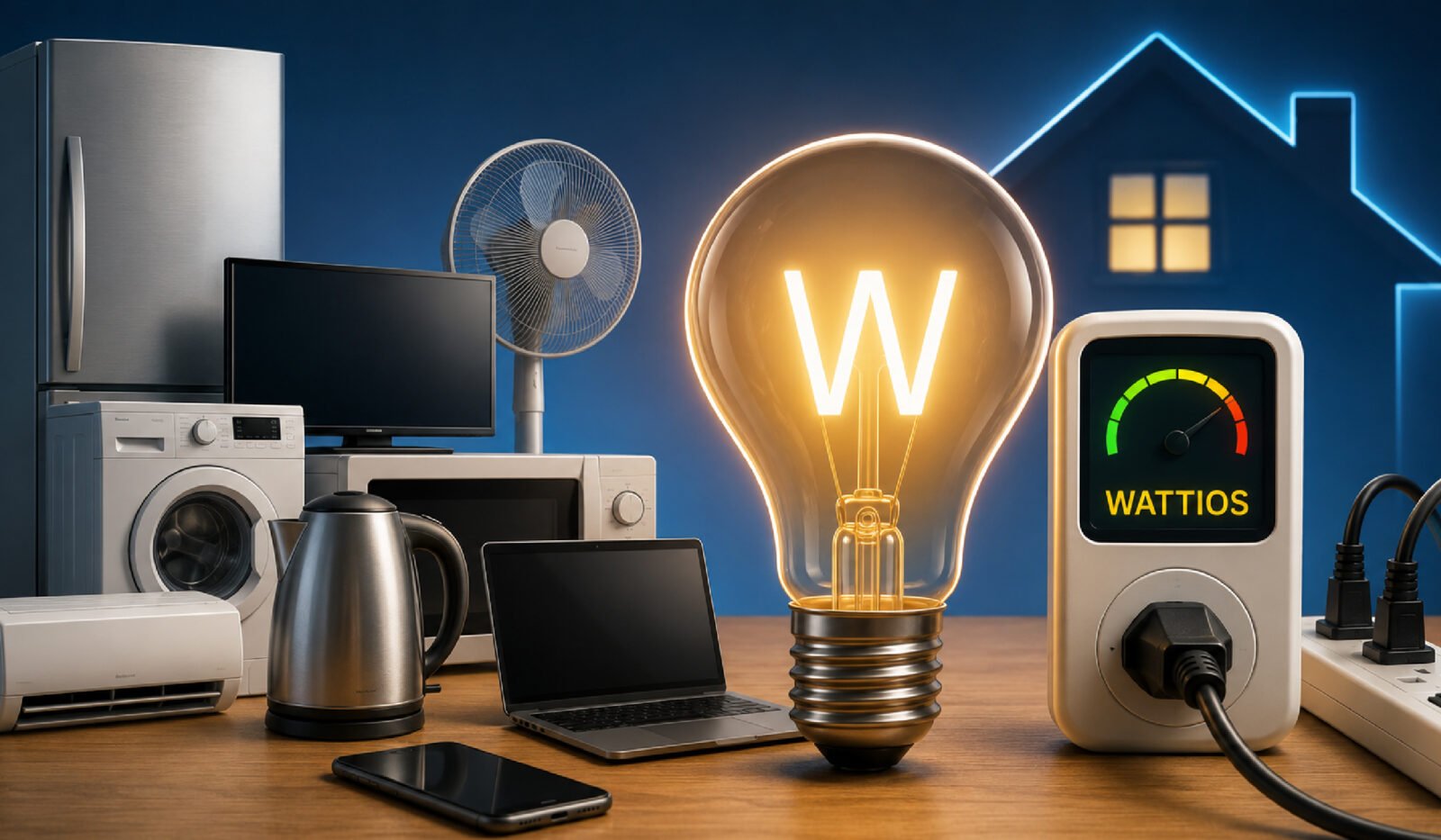
Understanding electricity becomes much easier when you know what wattios means and how power is measured. The term is closely connected with watts, the standard unit used to describe electrical power. You can find watt ratings on light bulbs, televisions, kitchen equipment, chargers, air conditioners, and many other electrical products.
Knowing these numbers can help you compare appliances and understand their electricity needs. It can also make electricity bills, energy labels, and solar power planning easier to understand.
This guide explains wattios in simple language. It covers watts, volts, amps, kilowatt-hours, appliance power ratings, electricity costs, energy efficiency, and practical ways to manage household electricity use.
What Does Wattios Mean?
The word wattios is associated with watts, a unit used to measure power. In the International System of Units, the watt has the symbol W. One watt represents a rate of energy transfer of one joule per second. NIST also describes a watt as a unit of power equal to one joule per second.
In everyday life, watts help show how much power an electrical device needs or delivers at a particular moment. A product rated at 100 W therefore has a different power requirement from one rated at 1,000 W. However, wattage alone does not show how much energy the product will use over an entire day or month.
Wattios, Watts, and Vatios: Understanding the Term
Readers may encounter different words when searching for information about electrical power. Watt is the SI unit name and W is its international symbol. In Spanish, vatio is commonly used for watt, with vatios as the plural. “Wattios” may also appear online, but it should not be treated as a separate electrical measurement.
The important point is the underlying unit. Watts measure power, not total electricity consumption over time. This distinction helps prevent confusion when reading appliance specifications or electricity information. A kilowatt represents 1,000 watts, while energy used over time is commonly expressed in watt-hours or kilowatt-hours.
Why the Watt Is Named After James Watt
The watt is named after James Watt, the Scottish engineer whose work on steam engines became important during the Industrial Revolution. His name later became associated with the standard unit of power. Today, watts are used far beyond mechanical engines and are familiar measurements in electricity, electronics, lighting, solar systems, and appliances.
The historical connection is useful because it explains why the measurement is called a watt rather than being represented only by a technical formula. Modern scientific standards define the watt precisely as a unit of power. One watt corresponds to energy being transferred at a rate of one joule every second.
How Electrical Power Works
Electrical power describes how quickly electrical energy is being transferred or converted. Watts provide a convenient way to express that rate. A device with a larger watt rating can involve a higher rate of energy transfer while operating, although that does not automatically mean it will consume more energy over a whole month.
Operating time matters as well. Consider a powerful kitchen appliance used for only a few minutes compared with a smaller electronic device operating all day. The second device can build up significant energy use because it remains active much longer. This is why understanding both watts and operating time gives a clearer picture of electricity consumption.
Wattios, Volts, and Amps Explained
Watts, volts, and amps describe related but different electrical quantities. Amps, or amperes, measure electric current. Volts describe electric potential difference, while watts measure power. For a simple DC circuit, or a purely resistive AC load, power can be calculated using P = V × I, where P is watts, V is volts, and I is amps. NIST lists the watt in relation to joules per second and also expresses the volt in terms of watts per ampere.
For example, 10 volts multiplied by 2 amps gives 20 watts in the simple case. Real AC equipment can require additional factors, so product specifications should be used when estimating actual appliance power.
Wattios vs Kilowatts, Watt-Hours, and Kilowatt-Hours
Watts and kilowatts measure power, while watt-hours and kilowatt-hours measure energy used over time. One kilowatt equals 1,000 watts. If a 1-kilowatt appliance operates continuously for one hour, it uses 1 kilowatt-hour of energy. Electricity companies commonly measure customer electricity use in kilowatt-hours, written as kWh.
This difference is important when discussing wattios. A 2,000-watt appliance does not automatically use 2 kWh. It would use 2 kWh if it operated at 2,000 watts continuously for one hour. If it ran at that power for only half an hour, its energy use would be 1 kWh.
How to Calculate Electricity Use From Watts
You can estimate electricity consumption when you know an appliance’s wattage and how long it operates. A simple formula is: Energy (kWh) = Power (watts) × operating hours ÷ 1,000. This works because one kilowatt equals 1,000 watts. EIA uses the same relationship when explaining how watts and operating time become watt-hours or kilowatt-hours.
For example, imagine a 100-watt device operating for five hours. It uses 500 watt-hours, or 0.5 kWh. If that happens every day for 30 days, estimated consumption is 15 kWh. Multiply that figure by your electricity rate per kWh to estimate the energy portion of the running cost.
Understanding Power Ratings and Appliance Energy Labels
Electrical appliances normally provide technical information that helps users understand their electrical requirements. Depending on the product and market, a rating label may show voltage, current, frequency, input power, model information, and other safety details. Wattage can provide a useful starting point when comparing the power requirements of different products.
However, a rated watt value does not necessarily mean an appliance constantly consumes exactly that amount. Refrigerators, air conditioners, washing machines, and other products can cycle, change operating modes, or use different amounts of power during different tasks.
For a better estimate of long-term consumption, consider the manufacturer’s energy-use information alongside the watt rating and your expected usage pattern.
Common Household Appliances and Their Power Use
Almost every powered appliance can be associated with a watt rating, but there is no single wattage that applies to an entire product category. LED bulbs generally require less power than many older lighting technologies for comparable light output, while heating and cooling equipment can have much larger electrical demands.
Televisions, computers, fans, refrigerators, washing machines, microwaves, kettles, air conditioners, and electric heaters all have different power requirements. Even two products of the same type may have very different ratings.
Size, design, efficiency, operating mode, temperature settings, and features can influence consumption. Instead of relying on a generic online wattage list, check the label, manual, or manufacturer information for the specific appliance you own or plan to buy.
How Wattage Affects Your Electricity Bill
A higher watt rating can increase electricity consumption when two appliances operate for the same amount of time under comparable conditions. However, wattage alone cannot tell you which appliance will contribute more to a monthly electricity bill. The number of hours it operates is also important.
For example, a high-power kettle may run for only several minutes each day. Another device with a much lower power requirement could remain active for many hours. Over a month, the longer-running device can accumulate considerable energy consumption.
Electric utilities generally measure electricity use in kilowatt-hours rather than simply charging according to an appliance’s watt rating.
Wattios and Energy-Efficient Appliances
Wattage is useful when comparing electrical products, but a lower number does not automatically mean a product is more energy efficient. Efficiency is about the useful result produced in relation to the energy required. Performance, capacity, operating time, and product design also matter.
For example, comparing two appliances only by their maximum watt ratings may give an incomplete picture if they have different capacities or operating cycles. Long-term energy information is often more helpful for products that switch on and off throughout the day.
When shopping, consider wattage together with appropriate energy labels, expected annual energy consumption, product size, useful features, and your normal usage habits. This creates a more realistic comparison of operating costs.
How to Measure and Reduce Electricity Use at Home
Understanding wattios can help you identify where electricity is being used, but reducing consumption usually requires looking at both appliance power and operating time. Start with devices that operate frequently or have significant electrical demand. Then consider whether they need to run for as long as they currently do.
Simple changes can include switching off equipment when it is genuinely unnecessary, using efficient lighting, selecting sensible heating and cooling settings, and maintaining appliances according to manufacturer instructions.
When replacing equipment, compare energy consumption as well as purchase price. Avoid assuming every standby device is a major source of waste. Measuring actual consumption with suitable equipment can provide better information than guessing from watt ratings alone.
Wattios in Solar Panels, Batteries, and Inverters
Watts are especially important when planning solar and backup-power systems. Solar panels are commonly described by power ratings, while inverters also have power limits that affect the electrical loads they can support. Household appliances running at the same time contribute to the total power demand placed on the system.
Battery planning introduces another important distinction: power and energy are not the same thing. Watts describe power, while watt-hours or kilowatt-hours describe quantities of energy. NIST lists one watt-hour as 3,600 joules, reinforcing this difference.
Proper solar or battery sizing involves factors beyond appliance wattage, including usage time, simultaneous loads, system losses, peak requirements, available sunlight, and equipment specifications.
Wattios in Homes, Businesses, and Industry
The concept behind wattios applies wherever electrical power is produced or consumed. At home, watts appear on appliances, lights, electronics, chargers, and other equipment. Offices use electrical power for computers, networking equipment, lighting, heating, and cooling. Shops and restaurants may have additional loads from refrigeration, displays, cooking equipment, and ventilation.
At larger scales, power is often expressed in kilowatts, megawatts, or gigawatts because individual watts would produce inconveniently large numbers. EIA explains that a megawatt equals 1,000 kilowatts, while a gigawatt equals 1,000 megawatts.
The scale changes, but the basic idea remains the same: watts measure power.
Common Wattage Mistakes and Misunderstandings
One common mistake is treating watts and kilowatt-hours as interchangeable. They measure different things. Watts describe power, while kilowatt-hours describe energy used over time. Another mistake is assuming the appliance with the highest watt rating must always be the most expensive one to operate.
Lower wattage does not automatically mean better efficiency either. The work performed, operating time, capacity, and design of the appliance need to be considered.
It is also important not to assume that Wattios is automatically the name of an AI energy-management service. Claims about a specific app, smart-home integration, subscriptions, or guaranteed energy savings require reliable evidence about that particular product or company before they should be presented as fact.
Why Understanding Wattios Matters When Buying Appliances
Understanding watts gives buyers another useful piece of information when comparing appliances. The cheapest product at the store is not necessarily the least expensive product to own over many years. A frequently used appliance can accumulate significant electricity costs during its working life.
Before buying, compare the purchase price, capacity, wattage, expected operating time, efficiency information, and features you will actually use. For appliances that cycle on and off, annual or standardized energy-consumption figures can be more informative than maximum wattage alone.
The goal is not simply to find the lowest-watt product. It is to find equipment that performs the required job effectively while keeping long-term energy use reasonable.
Final Words
Wattios is best understood in connection with watts and electrical power rather than as a separate unit of energy. A watt, represented by W, measures power and equals one joule per second. Kilowatt-hours, meanwhile, measure electricity used over time and are commonly used for utility measurement and billing.
Understanding this difference makes appliance labels and electricity calculations much easier to read. It can also help when comparing products, estimating running costs, reducing unnecessary consumption, or planning solar and battery systems.
You do not need advanced electrical knowledge to use wattage effectively. Knowing power, operating time, and energy consumption provides a practical foundation for making better everyday electricity decisions.
FAQs
What does wattios mean?
Wattios is best understood as a reference to watts in discussions about electrical power. A watt is the SI unit of power and has the symbol W. It represents an energy-transfer rate of one joule per second.
Are wattios the same as watts?
Wattios should not be treated as a separate scientific unit from watts. The internationally recognized SI unit is the watt, represented by W. Spanish commonly uses vatio and vatios when referring to the same unit of power.
What does 1 watt mean?
One watt means energy is being transferred, used, or produced at a rate of one joule per second. Watts therefore describe power rather than the total quantity of electrical energy consumed over a long period.
What is the difference between wattios and kilowatt-hours?
Watts describe power, while kilowatt-hours describe energy use over time. A device operating continuously at 1,000 watts, or 1 kilowatt, for one hour uses 1 kWh of electrical energy.
How do I calculate electricity consumption from watts?
Multiply the appliance’s watts by the number of hours it operates, then divide by 1,000. For example, a 200-watt device running for five hours uses approximately 1 kWh of electricity.
Do appliances with more wattios use more electricity?
Not necessarily over a day or month. Higher wattage means a higher power level, but total energy use also depends on operating time. A powerful appliance used briefly can consume less energy than a smaller device running continuously.
How can I find the wattage of an appliance?
Check the appliance’s rating label, user manual, technical specifications, or manufacturer information. Depending on the product, you may find watts listed directly or see other electrical information such as voltage and current.
Why are wattios important when choosing solar panels or an inverter?
Watt ratings help estimate how much power appliances require and how much load an inverter may need to handle. Solar and battery planning also requires operating time, energy capacity, peak loads, system losses, and other technical factors.
You may also read: FintechZoom.io Nasdaq: Complete Guide to Market Data, Charts, and Research